
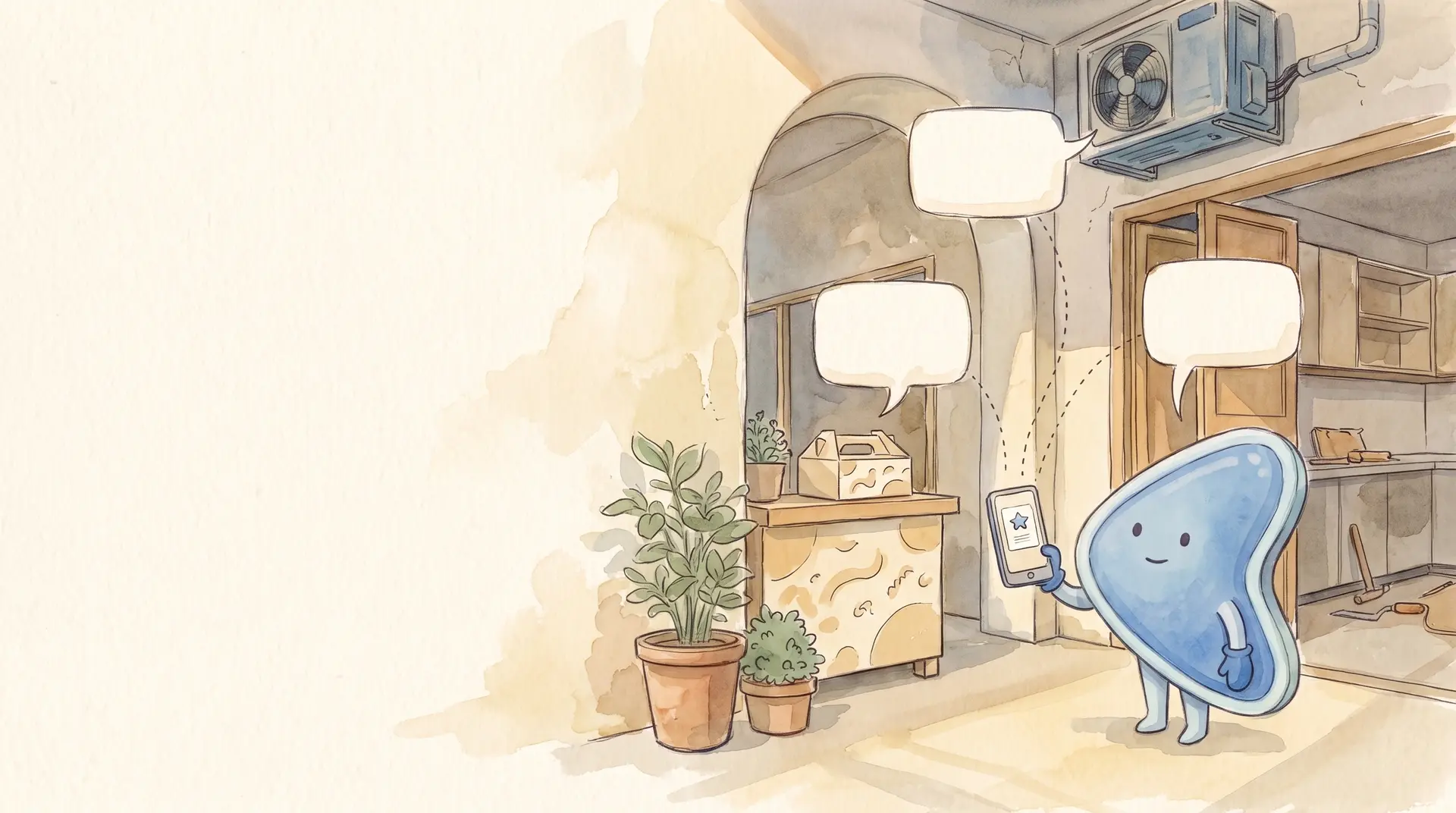
A standard ChatGPT ad click takes the customer to the advertiser's own landing page. When they come back and ask ChatGPT about prices, reviews or whether the business is real, it usually answers from its own web search, not from the ad.
In our test of follow-up questions about three Malaysian small businesses, ChatGPT cited the business's own website in only about one answer in four.
What does a customer see before clicking a ChatGPT ad?
Before the click, a ChatGPT ad shows the advertiser's name, logo, a headline, a short description and an image, and links to a landing page the advertiser chose2. It sits below ChatGPT's answer, labelled as sponsored1.
Who sees ads, and why an ad isn't a recommendation, is in Can I pay to get cited by ChatGPT? One newer detail matters for Malaysia: advertisers can opt into a setting that "automatically translates ad copy to a user's preferred language"5. So an English ad may reach a customer who chats in Malay or Chinese.
Where does a ChatGPT ad click take the customer?
A standard ChatGPT ad click takes the customer to the advertiser's landing page. OpenAI advises advertisers to "use product pages, collections, or content pages rather than defaulting to a generic homepage"3.
Three things happen behind the click:
- The advertiser may pay for it. ChatGPT Ads can be billed per valid click or per view2.
- The page must be open to OpenAI's crawlers. Landing pages "must not block" OAI-AdsBot or OAI-SearchBot3.
- The visit is tagged. An advertiser's own UTM tags "persist on ad clicks"2, and OpenAI adds a click reference called oppref for conversion tracking4. Unpaid ChatGPT visits are tagged differently (how to see them in Google Analytics).
In Sponsored Agents, a test with select US advertisers, the customer can first chat with "a business-sponsored agent", then follow a link to the website5.
Can a customer ask ChatGPT about the business in the ad?
A customer can ask ChatGPT about an advertised business, but ChatGPT doesn't see the ad unless they share it. OpenAI says: "By default, ChatGPT can't see the ads shown to you." A customer can tap the ad's menu and choose Ask ChatGPT to share it, and OpenAI adds that "Advertisers do not influence ChatGPT's responses about ads that are shared in the chat"1.
Asked in a new chat, without sharing the ad, "Is this company legit?" is treated like any question about a named business.
What does ChatGPT tell customers who ask follow-up questions about a business?
ChatGPT's follow-up answers about a business come from whatever pages its search finds. We asked about three real Malaysian small businesses, in English, Malay and Chinese, three times each. ChatGPT searched the web for 52 of 54 answers, and what it cited differed a lot by business.
| Business | Own website cited | What else the answers drew on |
|---|---|---|
| Aircon servicing firm, Klang Valley, prices on its site | 9 of 18 answers | Pages about similarly named aircon firms, a price article |
| Bakery chain, Klang Valley, prices on its site | 4 of 18 answers | Delivery apps, review sites, forums |
| Renovation contractor, Shah Alam, no prices on its site | 0 of 18 answers | Directory and classified listings, other firms' price guides |
Six questions per business, three runs each. Every answer is in the CSV. Why named businesses go uncited: mention vs citation.
Which follow-up questions decide whether the click becomes a customer?
Four things shaped what a customer would have heard in our test:
- "How much do they charge?" Where the business listed prices, ChatGPT quoted its own page in all 6 English answers. For the contractor, it gave market ranges from other firms' guides.
- "Is it legit?" ChatGPT looked for proof it could check, such as SSM registration. The contractor's site shows its registration numbers, but ChatGPT's searches never returned the site, and one answer called the firm "unverified".
- "Is it better than [rival]?" ChatGPT couldn't pick in 4 of 9 answers. It leaned to the rival in 2, to the business in 2, and said "it depends" once. One pick went to a rival with many directory reviews over the firm's own claims.
- Similar names, in any language. In 7 of 18 aircon answers, ChatGPT pulled in pages about similarly named aircon firms, such as a lookalike site with a different phone number. Asked in Malay for a price, it gave that site's price as this firm's in 2 of 3 answers.
It's the identity gap again. An ad brings the customer to the question; it doesn't choose the answer.
What can't our test tell me about follow-up questions after a ChatGPT ad?
- The ad itself. We showed and clicked no ads. We asked the follow-up questions in fresh chats, not through the Ask ChatGPT button.
- The app. We used OpenAI's API, which can answer differently from the ChatGPT app.
- Every business. Three businesses on one day is a snapshot, not a rule.
How do I make sure ChatGPT's follow-up answers back up my business?
Ads and recommendations do different jobs: an ad earns the click, and ChatGPT's follow-up answers help decide what happens next. Your own pages can help shape those answers.
- Request EasyFound's free check. See what ChatGPT tells a customer who asks about your business by name, then go through it with us on a free call.
- Put the answers on your own pages: prices or price ranges, service areas, your SSM number, halal status and where to find reviews, in plain text. Then check ChatGPT finds the page: our contractor's never came up.
- Ask the follow-ups yourself, logged out, in English, Malay and Chinese: "Is [your business] legit?", "How much does [your business] charge?"
- Check for lookalike names, using our identity checklist.
EasyFound is an AI search visibility (GEO) tool built for Malaysian businesses. It shows what six AI engines answer when a customer comes back from your ad and asks whether you're legit or what you charge. Those follow-up answers come from your public pages, which is where our AI SEO service does its work. Start with the free check below.
Sources
Our data: EasyFound, What ChatGPT cites when customers ask follow-up questions about a Malaysian business: 18 questions about three Malaysian small businesses (an aircon servicing firm and a bakery chain in the Klang Valley, a renovation contractor in Shah Alam), in English, Malay and Chinese, each asked three times on 1 October 2026 through OpenAI's API with web search available, location Malaysia, model gpt-5.4-mini, no chat history. Not the ChatGPT app, and no ad was shown. Each cited page was classified by source type with a hand-checked domain list; "similarly named" pages were checked by phone number, domain or product. Download the coded answers (CSV). We don't name the businesses, because one test isn't a verdict on them.
Other sources:
- OpenAI, Ads in ChatGPT, Help Center, read 1 October 2026 (link)
- OpenAI, Ads in ChatGPT: The Basics, Help Center, read 1 October 2026 (link)
- OpenAI, Create Ads for ChatGPT Ads, Help Center, read 1 October 2026 (link)
- OpenAI, Conversion Measurement, Help Center, read 1 October 2026 (link)
- OpenAI, Reimagining advertising with AI, read 1 October 2026 (link)
- OpenAI, Publishers and Developers FAQ, Help Center, read 1 October 2026 (link)
The test data is shared under CC BY 4.0: you're free to reuse it, with credit to EasyFound.
ChatGPT's ads programme is in beta and changing quickly; the details above were checked on 1 October 2026.
Research by Janice Pang, EasyFound.
 Will Gemini recommend my new business, or only the established ones? (Malaysia)
 Does ChatGPT name company setup firms when foreigners ask how to open a Sdn Bhd? (Malaysia)
 What does ChatGPT tell parents choosing an international school in KL? (Malaysia)